Personal Accident Insurance: Benefits, Coverage, Eligibility and How to Choose a Policy
Personal Accident Insurance may provide financial support for covered accidental death, injury or disability situations, subject to the terms, conditions and exclusions of the selected policy.
Accidents can result in unexpected medical expenses, temporary loss of income or long-term disability. Personal accident insurance can provide an additional layer of financial protection to help individuals and their families manage certain accident-related financial risks.
What is Personal Accident Insurance?
Personal accident insurance is an insurance policy designed to provide specified benefits when the insured person suffers a covered accident.
Depending on the policy, benefits may be available for accidental death, permanent disability, temporary disability or certain accident-related medical expenses.
The exact benefits depend on the insurance plan, sum insured, exclusions and policy conditions.
Why is Personal Accident Insurance Important?
An accident can create financial challenges for an individual and their family. In addition to medical expenses, a serious injury may affect the person's ability to work and earn an income.
Personal accident insurance can provide financial support for covered situations and may help reduce the financial impact of an unexpected accident.
- Provides financial protection against covered accidental events.
- May provide a benefit in case of accidental death.
- May provide compensation for covered permanent disability.
- Some policies may provide benefits for temporary disability.
- May cover certain accident-related medical expenses, depending on the plan.
- Can provide additional protection alongside health or life insurance.
How Does Personal Accident Insurance Work?
The policyholder selects an appropriate personal accident insurance plan and sum insured and pays the required premium.
If a covered accident occurs during the policy period, the insured person or nominee can submit a claim according to the applicable claim procedure.
The insurer reviews the claim and supporting documents. If the event and claim meet the policy conditions, the applicable benefit is paid according to the policy terms.
What Does Personal Accident Insurance Cover?
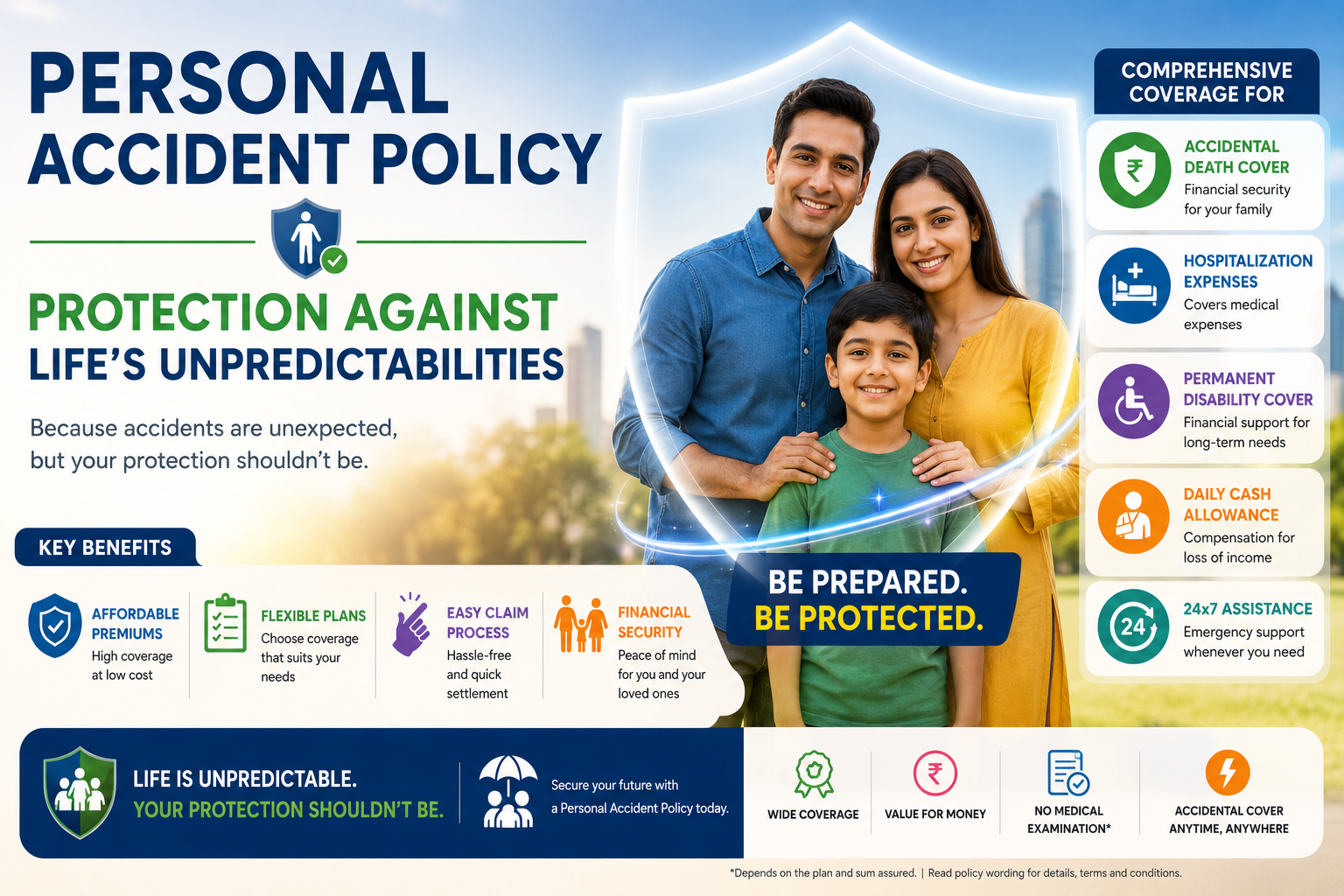
Coverage varies between insurance companies and policies. Depending on the selected plan, it may include:
- Accidental death.
- Permanent total disability.
- Permanent partial disability.
- Temporary total disability.
- Accidental hospitalisation expenses, where covered.
- Ambulance expenses, where covered.
- Accidental medical expenses, where covered.
- Education benefits for children, where included.
- Funeral or transportation benefits, where applicable.
- Other accident-related benefits specified in the policy.
Accidental Death Benefit
If the insured person dies due to a covered accident during the policy period, the nominee may receive the applicable accidental death benefit according to the policy terms.
The amount payable can depend on the sum insured and the conditions specified in the policy.
Permanent Total Disability Benefit
A serious accident can sometimes result in permanent total disability that affects a person's ability to work or perform specified activities.
If the policy covers the particular disability and the applicable conditions are satisfied, the insured person may receive a benefit based on the policy's disability schedule.
Permanent Partial Disability Benefit
Permanent partial disability refers to a covered permanent loss or impairment that does not result in complete disability.
Depending on the policy, the insurer may pay a percentage of the sum insured based on the type and extent of the covered disability.
The applicable percentage and conditions are specified in the policy document.
Temporary Total Disability Benefit
Some personal accident policies may provide financial support when an accident temporarily prevents the insured person from working.
This benefit may be paid periodically for a specified period, subject to the policy limits and conditions.
Accidental Medical Expenses
Certain personal accident policies may provide coverage for eligible medical expenses resulting from an accident.
This can include expenses such as hospitalisation, treatment or other accident-related medical costs when specifically covered.
Not every personal accident policy includes medical expense coverage, so the policy benefits should be checked before purchase.
Who Should Consider Personal Accident Insurance?
Personal accident insurance can be considered by individuals who want additional financial protection against accident-related risks.
- Salaried employees.
- Self-employed individuals.
- Business owners.
- Freelancers and professionals.
- People who travel frequently.
- Individuals who depend on their income to support their families.
- People who want additional protection alongside health or life insurance.
Benefits of Personal Accident Insurance
- Financial support after covered accidental events.
- Accidental death benefit for eligible claims.
- Disability benefits according to the policy schedule.
- Potential support for temporary loss of income.
- Additional accident-related medical coverage in selected plans.
- Financial protection for family members.
- Generally affordable additional insurance protection.
Personal Accident Insurance vs Health Insurance
Personal accident insurance and health insurance serve different purposes.
Health insurance primarily provides coverage for eligible medical and hospitalisation expenses resulting from covered illnesses, injuries or other medical conditions.
Personal accident insurance focuses specifically on covered accidents and may provide fixed benefits for accidental death or disability in addition to any medical expense coverage included in the plan.
Depending on an individual's needs, both types of insurance can provide different forms of financial protection.
Personal Accident Insurance vs Life Insurance
Life insurance is generally designed to provide financial protection in the event of the insured person's death according to the policy terms.
Personal accident insurance focuses on accidental events and may provide benefits for accidental death, disability and other covered consequences of an accident.
Personal accident insurance should therefore generally be viewed as additional protection rather than a complete replacement for life insurance.
What is the Sum Insured?
The sum insured is the amount of coverage selected under the personal accident policy.
The applicable benefit may be paid as a percentage of the sum insured depending on the type and severity of the covered event.
For example, a policy may provide the full sum insured for a covered accidental death while paying a specified percentage for certain permanent partial disabilities.
The exact benefit schedule should always be checked in the policy document.
How Much Personal Accident Insurance Cover Should You Have?
The appropriate coverage depends on income, financial responsibilities, lifestyle, occupation and the level of protection required.
When deciding the sum insured, consider:
- Annual income.
- Family financial responsibilities.
- Outstanding loans.
- Number of dependants.
- Occupation-related accident risks.
- Existing life insurance coverage.
- Existing health insurance coverage.
- Potential loss of income after a serious accident.
The goal should be to select coverage that provides meaningful financial protection while keeping the premium affordable.
What is a Disability Benefit?
A disability benefit provides financial compensation when an accident causes a disability covered by the policy.
The benefit can vary according to whether the disability is classified as total or partial and whether it is temporary or permanent.
Insurance policies generally contain a disability schedule specifying the percentage of the sum insured payable for different covered disabilities.
What are Policy Exclusions?
Exclusions are situations in which the insurer does not provide coverage under the policy.
Exclusions vary between insurance products, but may include certain circumstances involving self-inflicted injuries, participation in specified hazardous activities, criminal activities or other situations mentioned in the policy.
Some policies may also have specific exclusions relating to alcohol or drug-related incidents, depending on the policy terms and applicable conditions.
Always read the exclusions carefully before purchasing personal accident insurance.
Does Personal Accident Insurance Cover Natural Death?
Personal accident insurance is generally designed to cover accidental death rather than death caused by natural illness or disease.
Whether a particular event qualifies as accidental death depends on the policy definition and terms.
For broader death protection, a life insurance policy may be more appropriate.
Does Personal Accident Insurance Cover Accidents at Work?
Many personal accident policies can provide coverage for covered accidents regardless of whether they occur at home, at work or elsewhere, subject to the policy conditions.
However, specific occupations or hazardous activities may have exclusions or special conditions. Always check the policy wording for occupation-related coverage.
Does Personal Accident Insurance Cover Road Accidents?
Road accidents may be covered when they meet the definition of an accident under the policy and are not excluded by its terms.
Coverage can include applicable accidental death or disability benefits and, where included, accident-related medical expenses.
How to Buy Personal Accident Insurance?
- Assess your accident-related financial risks.
- Determine the required sum insured.
- Compare personal accident insurance policies.
- Check accidental death benefits.
- Review permanent and temporary disability benefits.
- Check accident-related medical coverage.
- Review exclusions and conditions.
- Check whether your occupation is covered.
- Compare premiums.
- Review the claim procedure.
- Provide accurate personal and occupation information.
- Complete the application and KYC process.
- Pay the applicable premium.
- Read the policy document carefully after purchase.
Documents Generally Required for a Claim
- Claim form.
- Policy details.
- Identity proof.
- Medical reports.
- Hospital records, where applicable.
- Discharge summary, where applicable.
- Accident or police report, where required.
- Death certificate in case of accidental death.
- Disability certificate or medical assessment, where applicable.
- Bank account details.
- Other documents requested by the insurer.
Personal Accident Insurance Claim Process
- Inform the insurer about the accident as soon as possible.
- Obtain medical treatment if required.
- Collect medical and accident-related documents.
- Complete the claim form.
- Submit the required supporting documents.
- The insurer reviews the claim and may request additional information.
- The claim is assessed according to the policy conditions.
- If approved, the applicable benefit is paid according to the policy terms.
How to Choose the Right Personal Accident Insurance Policy?
When comparing personal accident insurance, do not consider only the premium. The coverage and benefit structure are equally important.
- Sum insured.
- Accidental death benefit.
- Permanent total disability benefit.
- Permanent partial disability benefit.
- Temporary total disability benefit.
- Accidental medical expense coverage.
- Ambulance benefit.
- Education benefit, where available.
- Occupation eligibility.
- Policy exclusions.
- Claim process.
- Policy duration.
- Premium.
Renewal of Personal Accident Insurance
Personal accident insurance policies are generally issued for a specified policy period and may need to be renewed to continue coverage.
Policyholders should renew the policy before the expiry date and review the coverage during renewal to ensure it remains suitable for their current financial and personal circumstances.
Common Mistakes to Avoid
- Choosing coverage only because the premium is low.
- Selecting an insufficient sum insured.
- Ignoring disability benefit percentages.
- Not checking policy exclusions.
- Failing to disclose occupation accurately.
- Assuming every accident-related expense is covered.
- Confusing personal accident insurance with health insurance.
- Not checking the claim procedure.
- Allowing the policy to expire without renewal.
- Not reading the policy document carefully.
Important Things to Check Before Buying
- Sum insured.
- Accidental death coverage.
- Permanent disability benefits.
- Temporary disability benefits.
- Medical expense coverage.
- Occupation-related conditions.
- Exclusions.
- Policy period.
- Premium.
- Claim process.
- Renewal conditions.
- Additional benefits and riders.
Frequently Asked Questions About Personal Accident Insurance
What is personal accident insurance?
Personal accident insurance is designed to provide financial support for covered accidental death, injury or disability situations according to the policy terms.
Does personal accident insurance cover accidental death?
Yes, many personal accident policies provide an accidental death benefit when the death meets the policy definition and applicable conditions.
Does personal accident insurance cover disability?
Many policies provide benefits for specified permanent or temporary disabilities resulting from covered accidents.
Does personal accident insurance cover hospitalisation?
Some personal accident policies provide coverage for eligible accident-related hospitalisation or medical expenses. However, this benefit is not included in every plan.
Is personal accident insurance different from health insurance?
Yes. Health insurance generally focuses on eligible healthcare and hospitalisation expenses, while personal accident insurance focuses specifically on covered accidental events and may provide fixed benefits for death or disability.
Can I have both health insurance and personal accident insurance?
Yes. The two policies can provide different types of protection. Health insurance can help cover eligible medical expenses, while personal accident insurance can provide additional benefits for covered accidental death or disability.
Does personal accident insurance cover road accidents?
Road accidents may be covered if they meet the policy's definition of an accident and are not excluded under the policy terms.
Does personal accident insurance cover natural death?
Personal accident insurance generally focuses on accidental death and does not normally provide the same broad death protection as life insurance.
Who should buy personal accident insurance?
Anyone who wants additional financial protection against accident-related risks may consider personal accident insurance, particularly people with dependants or occupations involving higher accident exposure.
How much personal accident insurance should I buy?
The appropriate sum insured depends on income, family responsibilities, financial liabilities, occupation and existing insurance coverage.
Conclusion
Personal Accident Insurance can provide an additional layer of financial protection against the financial consequences of covered accidents. Depending on the policy, it may provide benefits for accidental death, permanent disability, temporary disability and certain accident-related medical expenses.
When selecting a policy, compare the sum insured, disability benefits, accidental death benefit, medical coverage, exclusions, occupation conditions, premium and claim process.
Personal accident insurance should be considered as part of an overall financial protection strategy and can complement health insurance and life insurance rather than necessarily replacing them.
Before purchasing a policy, carefully read the policy document and confirm the latest coverage, exclusions, benefit amounts and claim requirements with the insurer.
Disclaimer
This article is provided for general informational purposes only and does not constitute insurance, financial or medical advice. Coverage, premiums, eligibility, exclusions, benefits and claim procedures vary between policies and insurers and may change over time. Always read the policy document and consult the insurer or a qualified insurance professional before purchasing an insurance policy.